The Software Quality Checklist Your Team Is Missing
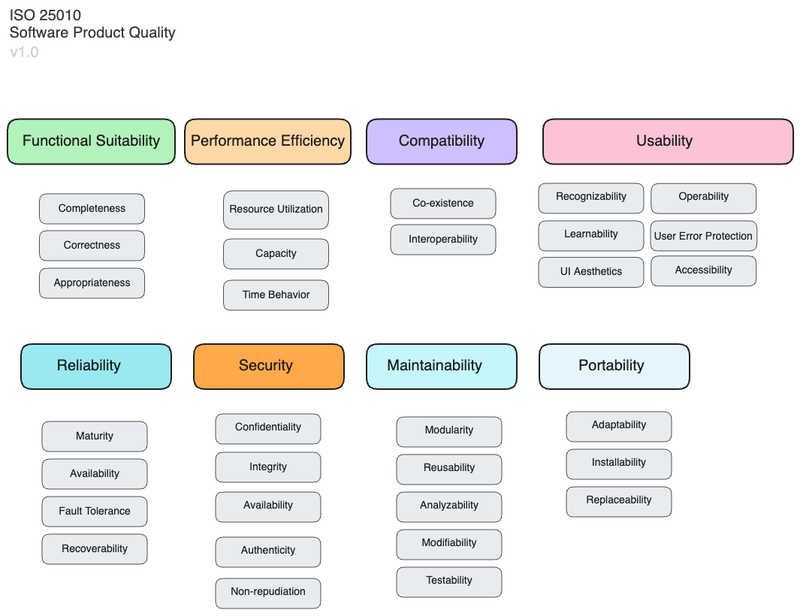
If your team can't name what "quality" means, you're shipping hope, not software.
ISO 25010 fixes that. It's a structured checklist from ISO/IEC that breaks "quality" into specific, measurable pieces so your team stops arguing about vibes and starts building to a standard.
Is the software built well?
Eight characteristics:
- Functional Suitability => Does it do what users actually need?
- Reliability => Does it keep working when things go wrong?
- Performance Efficiency => Is it fast and lean with resources?
- Usability => Can real humans figure it out without a manual?
- Security => Is data locked down from unauthorized access?
- Compatibility => Does it play nicely with other systems?
- Maintainability => Can your team change it without breaking it?
- Portability => Can it move between environments cleanly?
Does it actually help people?
Five characteristics:
- Effectiveness => Do users accomplish their goals?
- Efficiency => Do they accomplish them without wasted effort?
- Satisfaction => Do they feel good about the experience?
- Freedom from Risk => Are health, financial, and environmental risks managed?
- Context Coverage => Does it work across different situations and user groups?
Why this matters practically
Most teams optimize for one or two of these (usually functionality and performance) and ignore the rest until a production incident forces the conversation.
Each characteristic breaks into sub-characteristics with measurable criteria. Functional Suitability, for example, splits into completeness, correctness, and appropriateness. That specificity is the point. You can't improve what you haven't defined.
The bottom line: Use ISO 25010 as a pre-flight checklist. Before every release, walk your team through all eight product quality characteristics and ask: "Where are we strong? Where are we exposed?" The gaps you find before shipping are the crises you prevent after.
Written by

Written by